"What Do You Think About Second Amendment Solutions," Part V
The Movement Against Confederate Monuments in Dallas

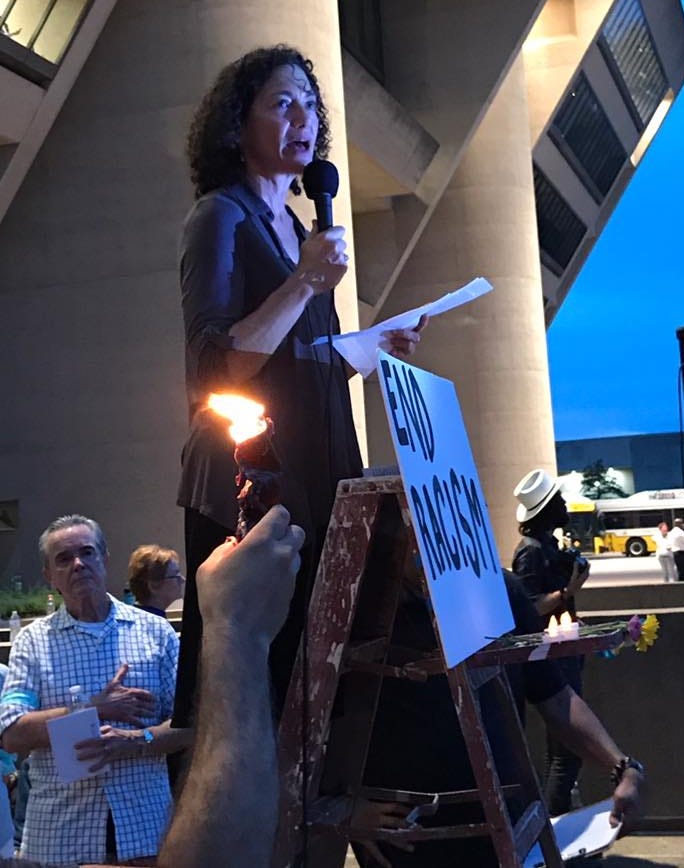
Rabbi Nancy Kasten, the Chief Relationship Officer at Faith Common in Dallas, speaks at a rally in front of Dallas City Hall on August 19, 2017 that called for the removal of Confederate monuments in the city. (Photo by Susanne York.)
As tributes to dead Confederates began vanishing from the Dallas landscape in 2017, I acquired a new nickname at my suburban college in Plano, Texas.
I was a history professor at Collin College, a multi-campus institution in hyper-conservative Collin County just north of Dallas. At that point, I had worked there for ten years.
I attended a question-and-answer session for a physical education professor seeking an appointment as associate dean. When I asked him about his view of faculty free speech rights he said, “Oh, you’re the Confederate monuments guy.”
Collin College President Neil Matkin did not see that nickname as a badge of honor.
I’m going to focus in some detail on the reaction of my college administration to the movement to remove Confederate monuments. I believe that Collin College set a precedent for the enormous attacks on campus protests and faculty and student free speech that would sweep Texas shortly after the start of the Covid-19 pandemic in 2020. Collin College’s assault on faculty engagement with public issues provided an unfortunate role model for other institutions.
As one fellow historian put it, Texas higher education would be “Collin-ized.”
In 2022, when I sued the college after it refused to renew my contract — in part because of my activism against the monuments — Matkin’s feelings about Confederate monuments and my efforts to topple them poured out.
He complained in a court deposition that he and other administrators, as well as college board of trustees members, had been flooded with mostly hostile phone calls about our campaign.[1]
In the same deposition, Matkin also compared taking down a statue of Robert E. Lee to the Taliban blowing up statues of Buddha in Afghanistan shortly before the Al Qaeda attacks on the United States on September 11, 2001.
Seven Collin College professors had signed an open letter published by the Dallas Morning News I co-authored that called for Dallas’ Confederate monuments to come down. More Collin College professors signed the letter than did faculty members from any other institution of higher learning in North Texas. This did not make Matkin proud.
During my legal battle with the school, I obtained a vast library of memos, emails, text messages, and other internal documents exchanged furiously among administrators. These were all about me. This torrent of umbrage began almost immediately after the Dallas Morning News published my open letter.
The court process revealed a June 6, 2020 memo Matkin wrote to other administrators. He expressed his disdain for faculty members’ exercise of off-campus speech:
“As long as I have the extraordinary privilege of serving as district president of Collin College, I will never, ever allow the institution to be utilized as a tool for any political effort or fall in line with those among us who have shown themselves to be professional activists.”
Matkin didn’t adhere to his own standards. A few years earlier, during a mandatory meeting for all college employees, he told the assembly that he would vote for then-State Rep. Jodie Laubenberg for “anything.” He then invited Laubenberg onstage and handed her a bouquet of roses.
Laubenberg had helped the college gain authorization to grant four-year degrees in nursing. She had also gained infamy when she suggested that women who get pregnant after being raped didn’t need access to abortion services because, she inaccurately insisted, “[I]n hospital emergency rooms, we have funded what’s called rape kits that will help the woman, basically clean her out. And then hopefully that will alleviate that.”
In other words it was o.k. for Matkin to force faculty to attend a mandatory impromptu campaign rally for an anti-abortion extremist who spewed misinformation, but faculty better not be activists for any stripe.
Also in the aforementioned June 6 memo, Matkin listed political “efforts” he didn’t want the administration, faculty, or staff to encourage others to engage in. He said it wasn’t the job of college employees to encourage others to “walk blocks for political candidates, help conduct the census, or to vote one way or the other on any point.”[2]
The U.S. Census is, of course, vital to the functioning of American democracy.
Representation in the United States House is divvied up based on state census numbers. The data collected by the U.S. Census Bureau helps determine the allocation of state funds to states and local governments and to assess how much funding an area might need for disaster relief. Social scientists can use information gathered by census-takers to measure the impact of government policies.
Matkin never clarified why he thought encouraging people to be census takers represented political activism. I consider participation in the census to be good citizenship. Perhaps, even while he was pretending to be politically neutral, Matkin was simply echoing right-wing attacks on the U.S. Census.
Matkin then falsely suggested that those of us publicly opposing Confederate monuments had implied that Collin College endorsed our viewpoints.
He claimed he had been contacted by “multiple legislators, attorneys, and citizens wanting to know the college’s position on that set of issues.”
He then warned, “Our classrooms will not be fodder for community organizers of any kind,” he said. “ . . . It does not forward the mission of the college to allow ourselves — when representing the college — to become embroiled in hotly contested political issues that serve to detract from our mission.”
Of course, if adopted by all colleges and universities, that approach to higher education would silence most of the experts in every conceivable academic field. Scholars would be blocked from sharing their hard-earned and badly needed expertise on a variety of vital topics such as racism, threats to democracy, income inequality, climate change, public health threats, imperialism, and issues of war and peace.
As the anthropologist John Traphagan wrote:
[I]f you are an intellectual, you shouldn’t spend your career just talking to other intellectuals. You have an obligation to engage the general public and bring what you learn in your studies to a wider audience. And that engagement means you also have an obligation to listen to the general public and understand how those who have not had the luxury of a life of study view the world.
During the last two years, an American measles epidemic reached a thirty-five-year high, largely fueled by the paranoid and ill-informed anti-vaccine movement. This rolling tragedy, enabled by the Trump administration, illustrates the danger when experts are silenced and the public forum is conceded to cranks.
I’ve always believed that well-informed scholars who don’t engage in public debates are like scientists who discover a breakthrough cancer treatment but don’t share the lab results with the world.
Matkin would succeed in his efforts to stifle community engagement, and in the process suffocate the intellectual life of a college system with an enrollment of about 60,000.
In spite of that, the anti-Confederate monument movement in Dallas chugged along. My involvement continued even as we encountered surprising obstacles.
Our campaign drew opposition from an assorted grab-bag of extremists, including the Sons of Confederate Veterans, a hate group called the Proud Boys, and an armed militia that pretentiously calls itself “This is Texas Freedom Force.”
Sadly, these white supremacists exploited a former Dallas City Council member, an African American woman named Sandra Crenshaw, to front for them.
Crenshaw served a single term on the city council from 1993-1995. Since then, she has been a perennial political also-ran, with numerous unsuccessful campaigns to regain a seat on the Dallas City Council or to serve in the Texas House of Representatives.
The Dallas Observer described Crenshaw in 2014 as a public figure with a “‘long and well-documented history of erratic behavior, the most recent case involving the alleged theft of a rental car,’” who was described in court documents as “mentally ill.”
Almost as soon our movement to remove Confederate monuments took off in August 2017, Crenshaw became a featured speaker at Dallas rallies organized by Civil War reenactors in Confederate Army uniforms and masked white men in camo.
Crenshaw declared that she was descended from Confederates, and became a monument defender.
Far right-wing news outlets like Breitbart hailed Crenshaw as a brave truth-teller. She founded “Dallas Area Black Americans for Democracy,” described by Breitbart as “a group aligned with Sons of Confederate Veterans and the Buffalo Soldiers in the war against eradicating Texas history.”
At a September 17, 2017 rally, after a giant Robert E. Lee statue had been removed from what was still called Lee Park, the pro-monument coalition carried protest signs that said, “Restore General Lee, Remove Rawlings,” referring to Dallas Mayor Mike Rawlings. They also cluelessly played the abolitionist hymn “Amazing Grace.”
Crenshaw presented herself as a defender of history. “When they took Lee out of this park, did they take your family’s heritage, your history, your love for this state, your love for this country, did they take that out of your heart?”
The military cosplayers in the crowd shouted, “No!”
In spite of that sad sideshow, the de-Confederation of Dallas continued. On September 22, 2017 Lee Park received a new name: Oak Lawn Park. That had been its original name, changed in 1938 to honor General Lee.
On April 4, 2019, the Dallas Park and Recreation Board would change its name yet again, this time to Turtle Creek Park.
Gay Donnell Willis, president and CEO of the Turtle Creek Conservancy, said the name change was necessary because the Lee Park name had become associated with civil strife.
“People didn’t want to book events at a place where there were police cars and people with guns and protestors,” he told the local Fox News affiliate. Willis said that the Turtle Creek name would restore wedding business that had nose-dived ever since the monument controversy.
Lee Daugherty, the co-founder of Take Back Oak Lawn, supported removing Lee’s statue and his name from the park. However, he questioned why the original name for the site was being abandoned. He implied the reason was homophobia.
“I would like the clarification of why Oak Lawn costs donors or why Oak Lawn can’t book weddings,” Daugherty said. “I think there are larger issues at play here.”
Daugherty suggested that the name was being changed a third time because of the association many made between Oak Lawn and the neighborhood’s large and politically active LGBTQ+ community.
Meanwhile, on September 29, 2017, Dallas Mayor Mike Rawlings’ Task Force on Monuments made sweeping recommendations regarding the final disposition of the bronze Lee equestrian statue that had been removed from Lee Park two weeks earlier. They also outlined plans regarding the 65-foot Confederate War Memorial near the Dallas Convention Center and what to do with streets, parks and other places named after Confederates.
As NBC5 reported:
[T]he task force said the Robert E. Lee statue, which was removed from Lee Park earlier this month, and the Confederate Monument in Pioneer Cemetery, should be preserved and placed in a museum or educational site in North Texas with the proper context of the Civil War, Reconstruction, the ‘Lost Cause’ mythology and the ‘Jim Crow’ era.
The Dallas Independent School District moved much faster than the city council. Campuses named after enslavers became painfully embarrassing in a school district where Latinx or African American students made up 92 percent of the population.
As longtime columnist Jim Schutze pointed out in the Dallas Observer, “Jefferson Davis Elementary, named for the president of the Confederacy, serves a student population that is 98 percent black and Hispanic.”
For years, the Dallas School Board had ignored the pleas of activists to remove Confederate names from campuses.
One member of our movement, cultural geographer Ed Sebesta, told Schutze that years earlier he had written to a now-deceased member of the board, Yvonne Ewell, asking her to lead the effort to change the name of Jefferson Davis Elementary School. He hoped Ewell, an African American, would feel she had a stake in the issue.
“I never heard a word from her,” Sebesta (who is white), ruefully told Schutze.
By 2017, times had clearly changed.
Even though I had gotten in trouble with my college for being a “professional activist,” I authored another op-ed, published by the Dallas Morning News on September 22, 2017 headlined “Why Cabell Elementary Needs a New Name Right Away.”
Dallas had four elementary schools named after Confederate military leaders: William Cabell (a Confederate brigadier general elected mayor of Dallas in 1874, 1877, and 1883); Robert E. Lee; Thomas “Stonewall” Jackson; and Albert Sidney Johnston. I found it particularly egregious for the Dallas school system to include an elementary school named after Cabell.
As I noted in my op-ed, Cabell was “a war criminal involved in the massacre of wounded African-Americans troops in the April 18, 1864, Battle of Poison Spring in Arkansas.” I continued:
Members of the [United States Army’s] 1st Kansas Colored Infantry were protecting an army wagon train delivering food to Union soldiers when they were ambushed by Confederate troops commanded by Cabell. After the battle, the Texas 29th Cavalry roamed the battlefield, murdering wounded African-American soldiers. They chanted, “Where is the 1st Kansas [racial slur] now?” replying, “All cut to pieces and gone to hell by bad management.”
After Cabell’s soldiers seized the 1st Colored Infantry’s wagons, each driver, according to one account, “vied to see if he could crush the most ‘[racial slur] heads’ under his wagon wheels.” The Confederates, furthermore, desecrated the bodies of the black soldiers, their stiff corpses used as headstones in the burial of white troops. Cabell’s men later murdered African-American troops in another attack a few days later near Poison Spring.
The slaughter became so infamous that "Remember Poison Spring" became a battle cry among African American troops fighting in the U.S. Army during the remainder of the Civil War.
As happened with so many other tributes to the Confederacy, the Dallas School Board named an elementary school after Cabell in 1958 at the height of Jim Crow while it for decades resisted implementing the 1954 Brown vs. Board of Education Supreme Court decision that ordered the desegregation of public schools across the country.
When the Dallas Morning News published my op-ed, I received a phone call from one prominent Dallasite and an email from another.
A Dallas school board member phoned me and told me that his peers clearly favored changing the names of the schools named after Lee, Jackson, and Johnston, none of whom had any known connection to Dallas history. Cabell, however, had been a three-time mayor.
The board member wanted to verify Cabell’s record as a war criminal. He was satisfied with the information I provided him and went on to support name changes for all four schools.
An email came from William Murchison, for more than twenty-five years a reactionary columnist for the Dallas Morning News.
When Murchison died October 8, 2025, former Morning News editorial page editor Rena Pederson described him as a "a true southern gentleman" with a great sense of humor. Etiquette and charm aside, he also signed his name to the incorporation papers for the League of the South’s Texas affiliate.
The Southern Poverty Law Center designated the League of the South as a hate group in 2000 because of its claims that Jews conspire to undermine white civilization and that African Americans thrived under slavery. The League also calls for Southern states to again secede from the United States in order to protect the region from the supposed scourges of LGBTQ+ rights and multiculturalism.
As a member of such a group, it’s not surprising that Murchison responded negatively to our movement. At the beginning of our anti-monument campaign, he authored a Dallas Morning News column in which he declared:
The whole enterprise of taking down statuary to appease the ideological passions of a talkative handful is silly. I cannot think of a better word for it. It's ridiculous: unworthy of a mature and sensible people.
Murchison’s long tenure at the Dallas Morning News illustrates the commanding role the local media played in normalizing “genteel” white supremacy.
Murchison thought it was mature and sensible to establish a new, white-dominated Southern theocracy. Now in his email to me he wanted to know the basis for my war crimes charges against William Cabell.
I directed him toward Mark K. Christ’s chilling and exhaustively researched book “All Cut to Pieces and Gone to Hell: The Civil War, Race Relations, and the Battle of Poison Spring.”
I never heard back from Murchison. Fortunately, Dallas no longer belonged entirely to the likes of him.
On September 29, the Dallas school board voted 9-0 to take Lee, Jackson, Johnston, and Cabell’s names off its schools.
On December 15, 2017, the board renamed Cabell Elementary as Chapel Hill Preparatory, Stonewall Jackson Elementary as Mockingbird Elementary, and Robert E. Lee Elementary as Geneva Heights Elementary. Albert Sidney Johnston Elementary became Cedar Crest Elementary.
Crews removed the old signs and installed ones with the new names in June 2018. Another wave of name changes followed in 2021 with students and parents now participating in the drive to rid the school district of its Confederate stain.
Schools still named after Confederate officers (John Ireland Elementary, the Sidney Lanier Expressive Arts Vanguard, John H. Reagan Elementary, Edward H. Cary Middle School, and Stephen J. Hay School) all received new designations. One school district leader praised the grassroots activism, including among children, that led to the changes.
"I couldn't be more proud of the students to do their diligence, learn their history, [and] look at other options," Dallas ISD Board President Justin Henry told Dallas’s Fox News affiliate.
The movement to remove tributes to the Confederacy was never about “erasing history.” In fact it became the biggest public history project Dallas ever engaged in.
Local columnist Jim Schutze’s 1987 book The Accommodation: The Politics of Race in An American City, was the first detailed study of racism in Dallas. It is badly dated, completely ignored the presence of the Mexican American community, overlooks African American resistance to white supremacy, and is condescending to the white working class.
Nevertheless, Schutze remains an influential opinion maker in Dallas. At one point, he opposed monument removal.
“At first I was a leave-’em-aloner, and then in the middle of the fight I switched sides and became a take-’em-downer,” Schutze wrote in the Dallas Observer. “That’s called journalistic privilege. We try to look ahead and guess which side’s going to win.”
The campaign we started, the columnist admitted, had electrified the city. As Schutze noted:
The bottom line is this: In a period of three or four weeks, the issue of Confederate memorials in Dallas has sparked more open candid discussion of slavery, the Civil War, racism and Southern cultural tradition than Dallas has seen probably since the Civil War. And, man, did we ever need it.
That was always the point.
Schutze and I later had a serious falling out, stemming largely from the repeated excuses he made for Amber Guyger, the white Dallas police officer who shot an African American man, Botham Jean, to death on September 6, 2018, while he ate ice cream in his apartment.
Schutze, however, credited Ed Sebesta and me with launching an essential dialogue we all hoped would be redemptive.
“One of the best things to come out of this debate about the statues has been the attention brought to the work of people like cultural geographer Ed Sebesta and historian Michael Phillips, both of whom have their hands on the goods, the evidence, the real stuff.” Schutze wrote. “By unearthing statements on race and slavery written by Confederate leaders, Sebesta and Phillips have put the incontestable lie to the notion that the war was not about slavery.”
We seemed to have momentum. Then the Dallas City Council threw us the weirdest of curveballs.
After the Council moved quickly to remove the Lee statue in 2017, it punted the ball to city staff to make recommendations on further actions, including what to do with the 60-plus-foot Confederate War Memorial that towered near the Kay Bailey Hutchison Convention Center, not far from City Hall.
The monument included statutes of Confederate Generals Lee, Johnston, and Jackson, Confederate States of America President Jefferson Davis, and a generic representation of a Confederate soldier that towered on the top.
Peter Simek, a reporter for D Magazine, believed there was only one obvious moral choice the staff could make about the Confederate War Memorial:
The only way to unseat the triumphalism of the dream of a white dominated society that is written into the very aesthetic form of the moment is to tear it down, no matter the cost . . . [T]hat is what the council should decide to do tomorrow.
Instead, on March 21, 2018, the staff came up with proposed tepid half-measures that would keep the war memorial in place. To sanitize the monstrosity, the staff recommended posting signs at the site, for supposed context.
In an April 3, 2018 op-ed I wrote for the Dallas Observer, I pointed out the absurdity of such a move.
. . . [These signs] would be inconspicuous near the six-story behemoth. In any case, no plaque there, or alongside any Confederate icon, could be large enough to explain:
Southern slavery’s cruelty
“Secession ordinances” that proclaimed preservation of slavery the chief reason for secession
The monuments’ erection in an era when African Americans were denied the vote and input on monuments
The monuments’ appearance at the height of lynching
The fact that most monuments, including Dallas’ Confederate War Memorial, were the work of the United Daughters of the Confederacy, which sponsored student essay contests on topics such as the happiness of life on slave plantations and the heroic role of the Ku Klux Klan in saving the South from “negro rule.”
Provided cover by the city staff, on April 25, 2018, the Dallas City Council voted 9-6 to delay removal of the memorial, with no deadline for a decision.
In an attempt to mollify our movement, the council also authorized construction of a memorial marking the 1910 lynching in downtown Dallas of an African American, Allen Brooks.
Activists demanded to know why the city couldn’t both acknowledge a grave racial injustice and remove a racist eyesore from the landscape at the same time.
“Creating additional monuments that acknowledge some of the victims of the acts of those who [subscribe] to the racist ideologies is not going to mitigate the negative effects of their existence,” Dallas NAACP President Aubrey Hooper, said to the Texas Observer.
Mayor Mike Rawlings led the effort to delay removal. He was supported by three African American members of the council: Tennell Atkins, Dwaine Caraway and Casey Thomas.
Those members raised questions about the cost of removal, estimated at the time to be $280,000. As I noted in my op-ed ,that cost was “less than a quarter per resident and significantly less than the $400,000 in discounts and subsidies the city gave the National Rifle Association to host its annual convention in Dallas.”
Atkins, Caraway, and Thomas struggled to explain the difference between taking down the memorial and the earlier removal of the giant Lee statue. “Thomas said he wanted yet another task force to study the removal question, even though the question has been submitted to that painful process once already,” Schutze reported.
Caraway, the mayor pro tem, offered the most bizarre suggestion for what to do with the Gilded Age monument: place a statue Martin Luther King Jr. on top of a refurbished Confederate War Memorial.
“You take the five little people off those little stands where they are. You take off that man, you saw the other man off. You take him off. You take him off. You take him off at the top,” Caraway said during an interview with the Dallas Observer.
He continued:
Then just include, instead of destroy, maybe [Dallas lynching victim] Allen Brooks and a plaque with his history in bronze atop one of those pedestals. Include Pancho Medrano, who has been a civil rights icon back in the day, even walking with Martin Luther King, and the history of Pancho Medrano.
These are just examples. Include [former Dallas City Council member] Juanita Craft with the NAACP and all of the things that she’s been about here in the city of Dallas. Include Roy Williams [co-plaintiff in the lawsuit that created Dallas’ single-member-district City Council system], who’s been a discussion point, he and Marvin [Crenshaw] on one of those pedestals. And, maybe at the very top, here’s Martin Luther King.
That would make for one crowded, confusing monument. Caraway was unclear how all this commissioned art would be cheaper than simply removing the biggest Confederate monument in Dallas or how long such an elaborate makeover would take.
Kevin Felder stood as the only African American on the City Council to demand removal. He called for Dallas to finally confront its violent, racist past without more delay. “We cannot forget the fact that the journey did not come without pain, lynchings, burnings, bombings, and it continues to this day.”
Felder hinted that the mayor and his allies had a hidden agenda but didn’t specify what it was. As this city hall debate unfolded on April 25, Dallas police forcibly removed longtime anti-racism activist John Fullinwider when he loudly condemned the council decision to delay removal.
Fullinwider later theorized about what motivated Carawy, Atkins, and Thomas’s dithering. In an opinion piece published by the Dallas Weekly, he suggested that Mayor Rawlings flexed political muscle to ensure their compliance.
In his column, Fullinwider suggested that the three African American council members feared Rawlings might punish them if they continued to insist on monument removals. Proposed development projects could vanish. Rawlings’ big business allies could decide they didn’t want to invest in the South Dallas neighborhoods that Thomas, Atkins, and Caraway represented.
It was like an episode of the mob drama The Sopranos, only the chief characters were better dressed and spoke with a twang.
Philip Kingston, our earliest ally on the City Council, couldn’t conceal his contempt for what happened. “They [Dallas City Council] simply want to have this circus again before they actually vote to remove it,” he said. “It might be easier if we just die of embarrassment.”
By late July 2018, City Manager T. C. Broadmax sent a memo to the City Council saying his office was “considering a scope of work and contract with a local artist who is uniquely qualified to bring some additional expertise and staff resources to these efforts at Pioneer Cemetery and for the Confederate Monument.”
Kingston worried that the artist might be hired to simply “recontextualize” the still-standing Confederate War Memorial and it would remain in its present location forever. He even feared that, with enough delay, the Lee statue might eventually be reinstalled.
Eager to keep the issue alive, Fullinwinder and artist Giovanni Valderas began conducting the “Shame of Dallas Tour,” starting near a bronze sculpture of forty-nine longhorn steers guided by three trail drivers near the Pioneer Park Cemetery and close to the Confederate War Memorial.
“Our message for tourists and others is, ‘Enjoy the bronze cattle, but don’t miss the racist monument that is the shame of Dallas,’” Fullinwider said “The Confederate war memorial is a shrine to white supremacy, and it has no place in a modern, diverse city.”
Valderas added, “As an artist, I believe we should be honoring the people who fought against slavery, not the leaders who almost destroyed this country to preserve slavery.”
Then, suddenly, one of the biggest obstacles to monument removal on the Dallas City Council resigned.
On January 25, 2018, NBC 5 first revealed that Dwaine Caraway, the man who wanted to put a statue of Martin Luther King, Jr. on top of the Confederate War Memorial, had “received tens of thousands of dollars from a man who recently pleaded guilty to federal charges in an ongoing corruption investigation at Dallas County Schools.”
Questioned by the TV station at City Hall, the mayor pro tem admitted, “Now this probably doesn’t look too good.”
It didn’t.
On August 9, 2018, Caraway resigned from the City Council after he pleaded guilty to federal corruption charges. He had accepted close to $500,000 in bribes, according to the Dallas CBS affiliate, from a “company that received millions of dollars in contracts from the now defunct Dallas County Schools system, which was in charge of school buses across Dallas County.”
On April 5, 2019, a federal court sentenced Caraway to fifty-six months in prison.
By the time Caraway was sentenced, the Dallas City Council had already voted to dismantle the Confederate War Memorial. Litigation, however, would delay the inevitable. The Confederate War Memorial would be vandalized and spend months covered in tarp. But eventually it would be dismantled and hidden away. Texas, meanwhile, became a national leader in Confederate monument removal.
In my next post, I’ll wrap up this “short” history of the anti-Confederate monument movement in Dallas. I’ll describe how Dallas’s giant Robert E. Lee equestrian statue ended up at a South Texas golf course, talk about the fierce political backlash to our effort, and share what happened to the major players in this story.
If you liked this post, please consider subscribing. Like all the best things in life, it’s free. Also consider buying my book White Metropolis: Race, Ethnicity, and Religion in Dallas, 1841-2001 and the book I co-authored with longtime journalist Betsy Friauf, The Purifying Knife: The Troubling History of Eugenics in Texas.
[1] Oral and Videotaped Real Time Deposition of H. Neil Matkin February 8, 2023, Joseph Michael Phillips v. Collin Community College District, 164-165.
[2] Neil Matkin, “Re: Confidential Thoughts and Guidance for the Executive Leadership of Colling College,” June 6, 2020, (copy in author’s possession.)