Greg Abbott Says, "Confederates Sí, Cesar Chavez No!"
A Separate and Unequal Reckoning South of the Red River

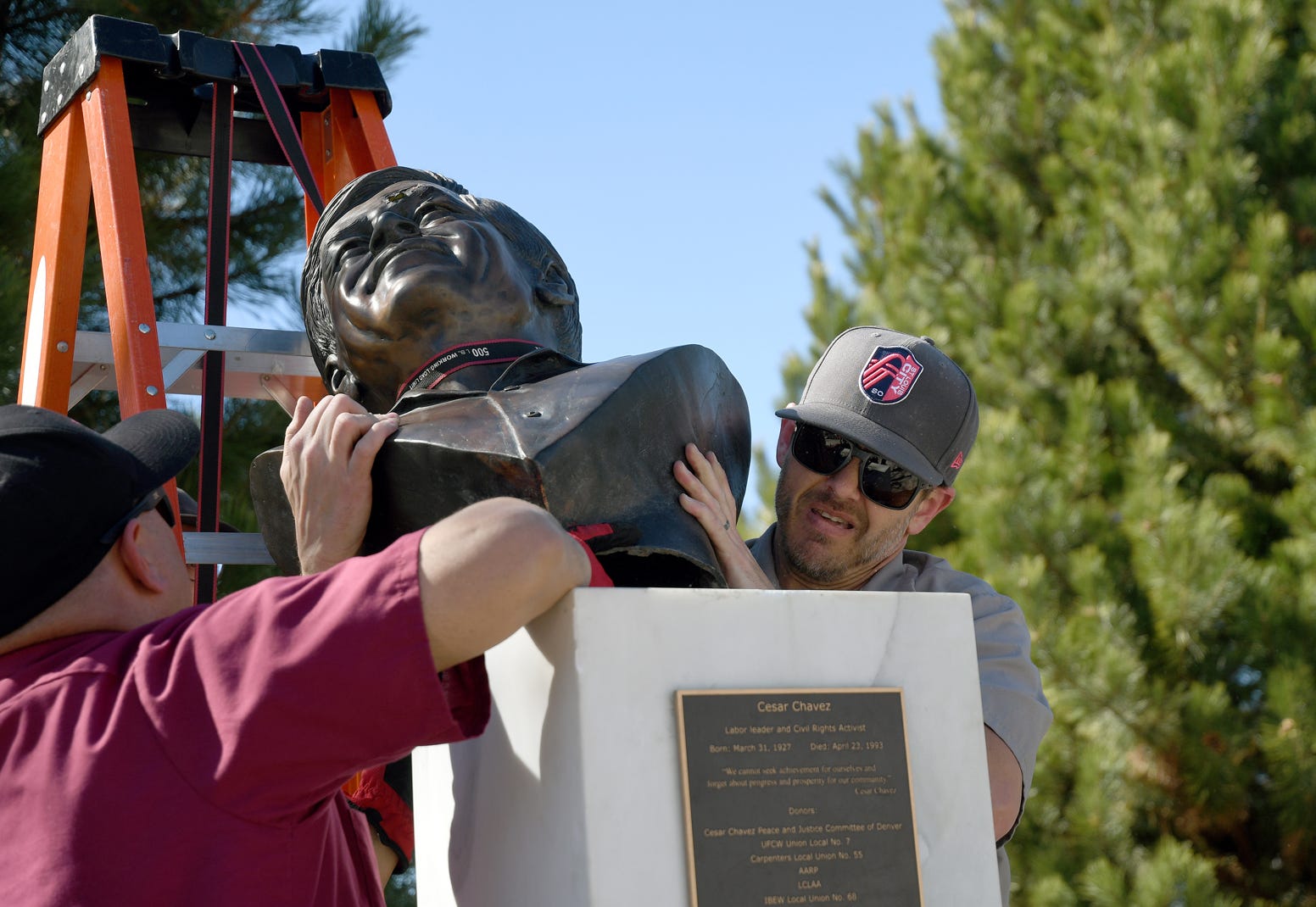
Workers remove a bust of the late labor leader Cesar Chavez shortly after the New York Times reported the civil rights icon had molested two children, raped fellow activist Dolores Huerta, and sexually and verbally abused others. Meanwhile, 162 monuments and other tributes to Confederates remain in the Lone Star State (Photo by The Associated Press.)
On March 18, Texas Gov. Greg Abbott discovered passion for not celebrating despicable people in American history.
That morning, the New York Times published the results of an exhaustive five-year investigation into Cesar Chavez, a man who for decades had become “one of the most revered figures in the Latino civil rights movement,” but who also, the newspaper revealed, led a sinister, stomach-churning life as a sexual predator.
A twelve-year-old and a thirteen-year-old numbered among Chavez’s victims. So did Dolores Huerta, another key leader, along with Chavez, of the United Farm Workers movement. The UFW fought the inhuman working conditions suffered by mostly Mexican and Mexican American farm workers in the agricultural industry in the American Southwest.
Huerta, nearly 96, revealed for the first time that Chavez, who died in 1993, raped her when she was thirty-six. As the Times reported:
Ms. Huerta struggles to reconcile the Cesar Chavez she knew, who inspired so many and achieved so much, and the man who assaulted her and publicly humiliated her. She said she was unaware of any sexual abuse of teenage girls. Moments after some of that abuse was described to her, Ms. Huerta broke down, sobbing and wailing.
“It’s kind of like a Dr. Jekyll and Mr. Hyde situation I think,” Ms. Huerta said of Mr. Chavez.
Historians had for a long time written about unsavory aspects of Chavez’s career. While head of the UFW, Chavez seethed with contempt toward undocumented migrant farmworkers he regularly referred to by the racist epithet “wetbacks.” As the historian Eladio Bobadilla observed:
He was relentless in his efforts to halt immigration from Mexico and was active in pursuing the deportation of those already here. Chavez claimed that undocumented workers were driving down wages, and crucially, being used as strikebreakers. Both complaints had merit, of course. Mexican immigrants were routinely used to break strikes; their desperate situation often led them to take whatever work they could get, even if it meant clashing with the UFW’s goals . . . What is disturbing about Chavez and the union’s actions is how rigid and unwilling they were to consider that the issue was more complicated.
Under Chavez, in 1973 the UFW set up its own vigilante border guard, creating what it called “the Wet Line” near Yuma, Arizona. There, it “turned over immigrants crossing the border to the Border Patrol. At times, it engaged in physical confrontations, with numerous reports indicating that union guards routinely brutalized border crossers.”
As noted by the Los Angeles Times, “Chavez became increasingly paranoid and autocratic, particularly in his later years with the union . . . He purged many of the UFW’s most persuasive and popular organizers, after deeming them insufficiently willing to bend to his directives. Chavez even employed teachings from Synanon, the substance-abuse recovery organization that devolved into an abusive cult.”
Chavez’s rigid leadership ultimately undermined the farm workers’ cause even as it elevated his public stature. Chavez’s more sinister side, however, remained invisible to the general public.
Anointed as the solitary embodiment of a union that had 60,000 members at its peak in the 1970s, Chavez won plaudits, particularly after this death, his face beaming from murals and and pedestals and his name gracing public sites across the land.
Up until the recent revelations, according to the Associated Press, “more than 130 locations or objects in at least 19 states [had been named] after Chavez, including libraries, boulevards, community centers and public parks.”
But no more.
Officials in San Fernando, California promptly ordered the removal of a statue of Cesar Chavez at a park named after him. Crews also took down statues of Chavez at Fresno State, in Milwaukee, and at the Dallas Farmers Market. A bronze bust in Denver also went into storage even as brown paper covered a mural including Chavez at Santa Ana College in California. Replacing these tributes with new ones to Dolores Huerta became a popular cause. Meanwhile in the Lone Star State, according to the Texas Tribune:
The allegations have also prompted Texas cities and groups to cancel or update events and celebrations. For instance, El Paso will observe March 31 as Community & Labor Heritage Day, while city council members in San Antonio, Austin and Dallas want to rename streets that were dedicated to him or stop recognizing Cesar Chavez Day. Houston’s annual march honoring him has also been canceled.
On March 23, the Texas Education Agency ordered the state’s public schools to erase any mention of Chavez from classroom lectures or materials. Until the New York Times story, the state social studies curriculum required lessons about Chavez for students at multiple grade levels and in American history classes. However, the TEA just sent a new decree to the state’s 1,207 school districts stating that deleting Chavez from lesson plans would not be “out of compliance with statutory requirements.”
The TEA told Texas superintendents that “any teaching of Chavez would . . . conflict with a portion of the Texas Education Code that says a teacher cannot be compelled to discuss ‘a widely debated and currently controversial issue of public policy or social affairs.’”
It is unclear if the entire history of the farmworkers movement and the Mexican American civil rights struggle will be erased from Texas school rooms along with any mention of Chavez.
Not surprisingly, Gov. Greg Abbott exploited the New York Times exposé in the most cynical, partisan, and hypocritical fashion possible.
Abbott highlighted Chavez’s crimes as a chance to take a swipe at the political left. He issued an executive order on March 18 cancelling the state’s César Chávez Day on March 31. The order read as follows:
The State of Texas will not observe the Cesar Chavez Day holiday . . . Reports of the horrific and widely acknowledged sexual assault allegations against Cesar Chavez rightfully dismantle the myth of this progressive hero and undermine the narrative that elevated Chavez as a figure worthy of official state celebration.
Abbott used the term “progressive” to link his left-leaning political opponents with a child molester. One can be certain that Abbott, who once lamented that he was not allowed to shoot undocumented workers crossing the Rio Grande, is not particularly concerned with Chavez’s victims. In 2024, Abbott enthusiastically endorsed Donald Trump for a second term term as president even though the latter is an adjudicated rapist.
Nor has Abbott renounced his repeated support for Trump even though the released files on convicted sexual predator Jeffrey Epstein contain testimony from a woman who said that Trump raped her when she was thirteen years old.
Abbott also did not act with such swiftness when it came to the monuments, schools, parks, or public roads that honor the rapists, human traffickers and traitors who formed the Confederacy and plunged the nation into a Civil War.
Back in 2015-2018 when the movement to remove Confederate monuments was at its peak nationwide (and Texas took down more than any other state in the nation), Abbott warned that removing heroic representations of enslavers would somehow prevent Texans from understanding their past. Abbott said:
[W]e must remember that our history isn’t perfect. If we do not learn from our history, we are doomed to repeat it. Instead of trying to bury our past, we must learn from it and ensure it doesn’t happen again. Tearing down monuments won’t erase our nation’s past, and it doesn’t advance our nation’s future.
Many of the enslavers who provoked the Civil War had something in common with Cesar Chavez. They sexually assaulted women and girls of all ages.
White rape of Black women reached pandemic levels in the antebellum South, from Virginia to Texas, as evidenced by the size of the mixed-race population recorded in the 1850 United States Census.
Enslaved women lacked the power to say no to their wealthy white abusers who made sexual demands. Courts did not recognize that the rape of the enslaved was even possible since the victims were classified as merely property, not humans with inalienable rights. In any case, enslaved raped women were not allowed to testify against their assailants in antebellum courts even though they were typically the only witnesses to the crime.
Yet the prevalence of antebellum rape by enslavers can be easily inferred, as the From Naming to Knowing website documents:
The rape of enslaved women by White men frequently resulted in the birth of multiracial children . . . almost 11 percent of the African American population at the time showed Black and White parentage, giving an indication of the likely scale of these offenses.
As the historian John R. Lundberg notes in his powerful new book The Texas Lowcountry: Slavery and Freedom on the Gulf Coast, 1822-1895 and Randolph B. Campbell in his classic An Empire for Slavery: The Peculiar Institution in Texas, 1821-1865, across Texas and the rest of the South, African American women were subjected to rape, forced breeding with enslaved men chosen by the enslaver, pedophilia, and voyeurism.[1]
Greg Abbott, rightly not wanting to honor a rapist who once was a Mexican American civil rights leader, nevertheless has no problem with honoring dead Confederates who enabled such monstrosities.
Texas still observes “Confederate Heroes Day,” which it has established in the most trollish way possible on the same day as Martin Luther King, Jr. Day, on January 19.
According to the Southern Poverty Law Center, as of November 2025, 162 monuments, plaques, place names, and other forms of tribute still honor the Confederacy across the Texas.
In Midland, Texas, as of 2020, a high school had long been named after Robert E. Lee, the Confederate commander of the Army of Northern Virginia, School leaders moved that year to change the name.
Robert E. Lee is not known to have raped anyone but that doesn’t mean that, in spite of decades of whitewashing mythology, he wasn’t a terrible person who let others rape and in other ways torment Black women.
As an enslaver, Lee ordered the whippings of two of his human captives who attempted to free themselves by escaping his plantation. In 1861, Lee offered his considerable military talents in the service of a treasonous rebellion against the United States that resulted in the death of almost 700,000 Americans, or 233 times the number killed by Osama bin Laden on September 11, 2001.
In 1863, Lee’s soldiers kidnapped hundreds of free African Americans in Pennsylvania and distributed them to enslaving families in the South after the Confederate forces retreated following their ignominious defeat in the Battle of Gettysburg.
Lee and his co-conspirators, of course, failed in their effort to establish the first nation, as Confederate Vice President Alexander H. Stephens put it, built “upon the great truth that the negro is not equal to the white man; that slavery subordination to the superior race is his natural and normal condition.”
For decades, Confederate apologists campaigned relentlessly to rehabilitate the image of Lee, portraying him as a tragic, kindly, almost saintly man who was personally opposed to slavery but who felt too much love for his home state to turn against it at a time of battle.
In reality, during his reign as president at Washington College (later renamed Washington and Lee), the wartime loser looked the other way when his students “formed their own chapter of the Ku Klux Klan, and were known by the local Freedmen’s Bureau to attempt to abduct and rape black schoolgirls from the nearby black schools.”
As Adam Serwer at The Atlantic wrote, Washington College students also likely participated in two attempted lynchings. Lee, known as a strict disciplinarian on more trivial matters, reacted with indifference when the young men in his charge regularly perpetuated horrors on the local African American community.
Lee also sought to keep African Americans chained in perpetual political servitude. In 1868, shortly before his death, he signed his name to the “White Sulphur Springs Manifesto”which read, in part:
[T]he people of the South, together with the people of the North and West, are, for obvious reasons, opposed to any system of laws which will place the political power of the country in the hands of the negro race . . . [A]t present the negroes have neither the intelligence nor other qualifications which are necessary to make them safe depositories of political power.
Midland, Texas sits in the western part of the state. It had at best an extremely marginal connection to the Confederacy. Yet, in 1961 (during the Civil War Centennial but also significantly during the height of the Civil Rights Movement) the Midland school district named its high school after Lee in spite of his despicable career.
That name was changed to Legacy High School in 2020, as the Texas Tribune wrote, as “part of the movement to remove the names of buildings and statues in public places honoring Confederate leaders like Lee, following the Black Lives Matter protests.”
However, while the left has swiftly pivoted away from Cesar Chavez in recent weeks, the right can’t quit its long-dead pro-slavery crusader.
According to an August 13, 2025 post by Newsweek:
The Midland Independent School District Board of Trustees voted 4-3 late on August 12, 2025, to revert Legacy High School to its original name, Midland Lee High School, restoring the association with Confederate General Robert E. Lee and applying the change to the freshman campus and a planned future site.
Midland ISD trustee Josh Guinn improbably insisted, "This is not a division — it's about honoring the patriotic legacy that binds us."
Meanwhile there could be no greater fan of dead Confederates than the man who reportedly considered Jeffrey Epstein his “best friend.”
Since regaining the presidency in 2025, Donald Trump made a priority of reversing an initiative under his predecessor Joe Biden to remove the names of Confederate military leaders from U.S. military installations. The renaming occurred in response to a 2021 federal law that required the expunging of Confederate names and symbols from all Defense Department property.
Under Biden the Pentagon gave Fort Hood in Killeen, Texas, named after John Bell Hood, an incompetent Confederate General with only a tangential relationship with Texas, a new moniker. The installation became Fort Cavazos in honor of the United States Army’s first-ever Hispanic four-star general.
Unlike Hood, Richard Cavazos is not known to have ever betrayed his country. Rather, he served in the Korean and Vietnam wars and earned a Medal of Honor. On July 15, 2025, Trump announced he was restoring the Fort Hood name.
At the same time, other public monuments to racists from the more recent past have re-emerged on the Texas public landscape.
In 1972, Arlington, Texas, a suburb between Dallas and Fort Worth became the new home of the ever-losing Washington Senator Majors League Baseball franchise. At that moment, cities like Dallas and Arlington were rebranding as modern, sophisticated center and trying to distance themselves from the toxic legacies of the Civil War and the nasty battles over segregation.
In naming their team, Arlington’s new baseball team owners tapped into a different regional mythology, thoroughly racist but associated not with Lee’s surrender at Appomattox at the end of the Civil War. They chose instead to invoke the “triumphant” Anglo colonization and conquest in the “Old West.”
Hence, the Dallas-Fort Worth area’s baseball team came to be called “The Texas Rangers,” after a law enforcement agency formed in 1835 as a genocidal military force used against Native Americans.
Over its history, the troubled state police agency behaved more like a terrorist militia toward the state’s indigenous, Mexican and Mexican American, and African American population. As Doug Swanson argued in his book Cult of Glory: The Bold and Brutal History of the Texas Rangers:
They burned peasant villages and slaughtered innocents. They committed war crimes. Their murders of Mexicans and Mexican Americans made them as feared on the border as the Ku Klux Klan in the South.
The Texas Rangers repeatedly gunned down Mexicans and Mexican Americans along the state’s southern border between 1910-1920, a time many Tejanos call “La Matanza” or “The Massacre” or the ““Hora de Sangre” or “the hour of blood”. The slaughter happened in an atmosphere of paranoia about a possible Mexican alliance with Germany in World War I and fear that radical politics might spill into Texas as the Mexican Revolution unfolded that decade.
As many as 5,000 Tejanos may have been murdered by whites that decade and the Rangers were frequent participants. One example of Rangers terrorism unfolded the morning of January 28, 1918 when Rangers gunned down fifteen unarmed men and boys in the South Texas rural community of Porvenir.
Because of this ugly history, when the new baseball team in Arlington announced its new name in 1972, Mexican Americans in the Dallas-Fort area protested. They were ignored.
The issue came up again during the nationwide reckoning with the United States’ racist history and culture that took place after the killing of George Floyd by a Minneapolis police officer on May 25, 2020. Chicago Tribune sports columnist Steve Chapman called on the baseball franchise to pick a new mascot.
Chapman wrote that calling the team the Texas Rangers is “an affront to Hispanics, African Americans and anyone who favors racial equity. It should be an intolerable embarrassment to the owners and fans.”
Chapman was also ignored and this season, the Texas Rangers owners decided to double down on the racist effrontery.
On March 2, the team unveiled an old “new” 12-foot statue in the left field concourse of Globe Life Field. The statue depicts a Texas Ranger law enforcement officer with his left hand extended as a warning and his right hand ominously poised above a holstered pistol.
The statue used to stand at Dallas Love Field but was removed in 2020 upon publication of Swanson’s Cult of Glory book. It had been hidden in storage at an airfield since. The Texas Rangers owners mysteriously decided to give it a new, prominent home.
The model for the statue was former Texas Ranger Captain E.J. “Jay” Banks, a man who won infamy in 1956 during the violent resistance to the desegregation of Mansfield High School near Arlington.
As Davy Andrews wrote for the Fangraphs website, when a judge ordered Mansfield High desegregated, “a mob of 400 people descended . . . to prevent Black students from registering. They blocked the doors. They hung effigies. They brought hunting dogs. They smashed the cameras of out-of-town reporters.”
Segregationist Gov. Alan Shivers sent Banks and other Rangers to prevent Black students from registering in spite of the court order. Banks enabled this violation of the law. A famous photograph published by Time Magazine shows him casually leaning against a tree as white students walk beneath an effigy of a Black man dangling thirty feet above the front entrance of the school. He did nothing to remove the effigy meant to frighten away African American students asserting their Constitutional rights.
Just a week later, as Andrews wrote, Banks refused to help two teenaged African American students assaulted by a mob that chanted “No NAACP Goons” and “Go North, N*****” when they tried to enroll at Texarkana College. When 17-year-old Steve Poster and 18-year-old Jessalyn Gray asked Banks for an escort, the lawman refused. He later got taken out for a chicken dinner by the appreciative local chapter of the racist White Citizens Council.
Banks was not just a white supremacist. He was also possibly a crook. Banks was later fired by Colonel Homer Garrison Jr. for repeatedly not following orders to raid illegal Tarrant County gambling operations. He then lost his job as chief of the Big Springs Police Department to investigate possible thefts by his officers.
Some hero.
The placement of the Banks statue at the Texas Rangers ballpark sends a similar message to Black and Brown Texans (and indigenous Texans as well) as that Black effigy allowed to hang for days at Mansfield High seven decades ago. United States Congressman Marc Veasey put it this way:
It sends a chilling message about which parts of history are being elevated and which sacrifices are being forgotten. Ballparks should be places where families gather, where children fall in love with the game, and where fans of every race, faith, and background feel welcome. Honoring a figure tied to resisting school integration — and doing so with imagery that evokes racist violence — sends exactly the wrong message about who belongs in that space.
Public memory of Cesar Chavez should take into account his terrible deeds. We shouldn’t commemorate rapists. In any case, any movement worth a damn is bigger than its purported leaders. But in Texas today, the historical reckoning for murder, rape and treason of past villains is separate, and unequal. Famous dead white people get a special pass. And statues raised in their honor.
If you enjoyed this post, please consider subscribing to my Substack. Like all the best things in life, it’s free. Please also consider buying my book, White Metropolis: Race, Ethnicity, and Religion in Dallas, 1841-2001 and the book I co-authored with longtime journalist Betsy Friauf, The Purifying Knife: The Troubling History of Eugenics in Texas.
Also, Please check out Bradford William Davis’s excellent reporting on the recently installation of the Banks stature by the Texas Rangers here.
[1] See John R. Lundberg, The Texas Lowcountry: Slavery and Freedom on the Gulf Coast, 1822-1895 (College Station: Texas A&M University Press, 139-140; Randolph B. Campbell, An Empire for Slavery: The Peculiar Institution in Texas, 1821-1865 (Baton Rouge: Louisiana State University, 1989), 154-155.